

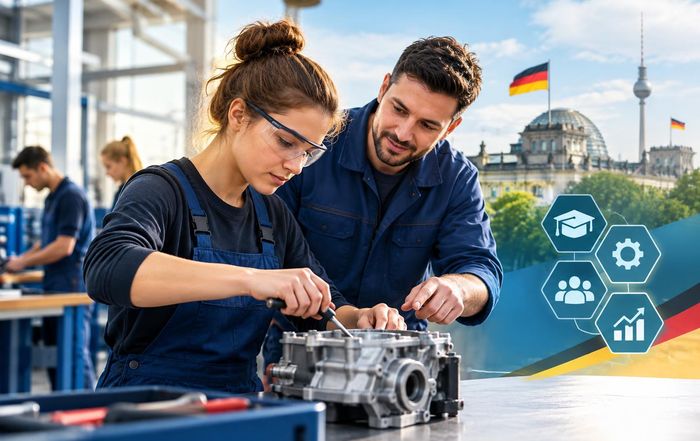
How Germany's Apprenticeship Model Supports Skilled Employment
Germany's apprenticeship system is often held up as a practical answer to a problem that many economies still struggle with: how to move young people and career changers into stable, skilled work without forcing every route through a traditional university degree. The model, usually discussed under the umbrella of the "dual system," combines classroom instruction with paid on-the-job training, and it remains deeply embedded in the country's labor market. That matters because skilled employment is not just a social policy goal in Germany; it is a core part of how firms staff factories, offices, logistics networks, hospitals, retail operations, and technical services. For readers following employment trends, the German example is useful not because it is easy to copy wholesale, but because it shows how training, certification, and employer participation can be aligned at scale.
The system's durability also makes it relevant beyond Germany. In an era when many countries are debating labor shortages, youth unemployment, automation, and the value of vocational education, the apprenticeship model offers a concrete case study in workforce design. Institutions such as the Federal Employment Agency of Germany, the Federal Ministry of Education and Research, and the Federal Institute for Vocational Education and Training all play roles in shaping and monitoring the system, while employers and chambers of commerce help define occupational standards. International organizations including the OECD and the International Labour Organization have repeatedly pointed to apprenticeship pathways as one of the more effective bridges between education and work. The result is a labor market mechanism that is less about abstract credentialing and more about producing workers with occupation-specific competence that employers recognize and trust.
Why the model matters to employers and workers
At its core, the German apprenticeship model reduces the distance between training and real work. Apprentices typically split their time between a company and a vocational school, learning both the practical routines of a job and the theoretical foundations behind it. That structure helps employers because they are not hiring purely on academic proxies; they are helping shape the skills they need and can see those skills develop over time. It also helps workers because they earn while they learn, gain a formal qualification, and enter the labor market with a clearer occupational identity than many entry-level pathways provide. For sectors covered by business, technology, and innovation, that combination of practical experience and recognized certification can be especially valuable when roles require more than general education but less than a university degree.
A major strength of the system is that it is not treated as a fallback option for students who "missed out" on higher education. In Germany, apprenticeships are a mainstream route into skilled work across trades, manufacturing, logistics, healthcare support, retail, and parts of the service economy. That social legitimacy matters. When vocational training is respected, more capable candidates are willing to consider it, employers can recruit more effectively, and the labor market avoids the stigma that often weakens similar programs elsewhere. The model also creates clearer progression: an apprentice can move into permanent employment, continue with advanced vocational qualifications, or later pursue further education. In practice, that makes the route more flexible than it is sometimes portrayed in international debate.
How the dual system is organized
The system's structure is what gives it much of its credibility. Apprenticeship occupations are nationally recognized and defined through standardized training regulations. Companies provide the workplace training, while vocational schools cover subjects such as technical theory, mathematics, language, and occupational law. This shared responsibility means the curriculum is not disconnected from the job, yet it is not left entirely to individual employers either. Standards are coordinated through public institutions and social partners, which helps preserve consistency across regions and sectors. For readers interested in founders and companies, that coordination is one reason German firms often treat apprenticeship participation as part of long-term workforce planning rather than a short-term recruitment tactic.
The role of employer organizations is especially important. Chambers and industry bodies help administer examinations and ensure that training content matches recognized occupational profiles. That keeps the qualification portable, which is one of the system's most important features. A young person who completes an apprenticeship in one part of the country does not simply hold a company-specific certificate; they hold a nationally recognized credential that signals competence to other employers as well. This portability reduces the risk that training becomes too narrowly tailored to one workplace. It also helps firms because they know the credential has value in the broader labor market, making it easier to recruit and retain talent in a system where workers can move between employers.
Why apprenticeships support skilled employment
The most direct reason the model supports skilled employment is that it creates a pipeline from learning to work. Rather than waiting until the end of formal education to discover whether a candidate can actually perform the job, employers and apprentices build that match gradually. This lowers hiring risk and improves the quality of labor-market matching, which is a major issue in many economies. It also helps explain why Germany has long been seen as relatively effective at transitioning young people into work. The system does not eliminate unemployment or skills mismatch, but it does reduce the gap between education and labor demand in many occupations. That is particularly relevant when economy conditions are uncertain and firms want workers who can contribute quickly.
The model also supports productivity in a more subtle way. Apprentices are not only trained for a first job; they are socialized into workplace norms, safety practices, and quality expectations. In industries where process discipline matters, that can be as important as technical knowledge. Apprenticeships can therefore function as a form of industrial capacity-building, especially in manufacturing and technical services where tacit knowledge is hard to teach in a classroom alone. Germany's broader reputation for precision engineering and mid-sized industrial firms is not the result of apprenticeships alone, but the training system clearly reinforces that ecosystem. It gives firms a way to transmit specialized know-how across generations of workers, which is a useful counterweight to labor-market churn.
The role of social partnership and wage structure
Germany's apprenticeship model also works because it is supported by a broader institutional culture of social partnership. Employers, trade associations, unions, schools, and government bodies all have defined roles. That does not mean there is always consensus, but it does mean the system is built on negotiation and shared standards rather than ad hoc arrangements. In practice, this reduces the likelihood that training quality varies wildly from one employer to another. It also helps align training with actual labor-market needs, which is one reason the model has remained resilient despite changing technology and business cycles. Readers following global employment patterns will recognize that this kind of coordination is rare in many labor markets, where training often falls either to schools alone or to employers without much public support.
Compensation matters too. Apprentices are typically paid, though earnings are lower than full wages because the training component is substantial. That makes the path more accessible than unpaid internships or purely academic routes that require students to absorb the full cost of education before earning. For households under financial pressure, that difference can be decisive. It also helps firms attract a broader pool of applicants, including those who may not be able to afford a longer period outside the labor force. At the same time, the wage structure is part of why the model depends on employer commitment: companies must be willing to invest in training even before they receive the full productivity benefit of the apprentice's work. In sectors where margins are thin, that can be a real constraint.
Where the system is under pressure
Even a strong apprenticeship model has limits. Germany has faced persistent challenges in filling all available training places, especially in some trades and regions. Demographic change has reduced the pool of young entrants, while higher education remains attractive to many students and families. Some occupations also struggle with public perception, particularly if they are seen as physically demanding, low status, or less future-proof than office-based careers. These pressures are not unique to Germany, but they show that apprenticeship systems still need active maintenance. The banking and stock markets sectors may attract more attention in policy debate, yet the labor-market backbone often depends on whether enough people are being trained for the less glamorous but essential roles that keep the economy functioning.
Another challenge is technological change. Automation, software adoption, and artificial intelligence are altering many occupations faster than curriculum updates can sometimes keep pace. Germany has tried to respond by modernizing occupational profiles and expanding training in digital skills, but the system must continually adapt if it is to remain relevant. That is especially true in areas where artificial intelligence is changing workflows in administration, logistics, design, and industrial maintenance. Apprenticeships can be a strength in this environment because they are close to actual work, but that same closeness means outdated training content can become a liability if employers and regulators move too slowly. The model works best when it evolves without losing its standardization.
Lessons for countries trying to build similar pathways
Many governments admire the German model, but direct transplantation rarely works. Apprenticeships depend on institutions that are easy to overlook: trusted certification, employer participation, vocational schools with adequate quality, and a labor market that values non-university credentials. Without those foundations, apprenticeship schemes can become fragmented or low status. Countries that want to strengthen skilled employment through vocational pathways often need to start with governance, not slogans. They must decide who sets standards, who pays, how quality is monitored, and whether apprentices have a clear route into permanent work after training. The investment required is not only financial; it is institutional.
Still, the underlying logic is transferable. Employers in many economies say they cannot find workers with the right skills, while young people often struggle to obtain experience. Apprenticeship systems can address both problems if they are designed well. They are most effective when they lead to recognized qualifications, when employers have enough incentive to participate, and when training is broad enough to support mobility rather than lock workers into one firm. Countries that pair apprenticeships with strong labor-market data and active public employment services tend to get better results than those that treat them as isolated pilot projects. For international readers comparing models, the German case shows that skilled employment is more likely to thrive when education is treated as a shared responsibility between the public and private sectors.
Why the model remains relevant now
The continuing relevance of Germany's apprenticeship system lies in its balance. It is practical without being narrow, standardized without being rigid, and employer-led without being purely private. That balance helps explain why it has survived shifts in technology, globalization, and labor-market preferences. It also offers a useful reminder that skilled employment does not emerge automatically from economic growth. It has to be built through institutions that connect learning with work and make the transition credible for both sides of the labor market. In that sense, the apprenticeship model is not simply an education policy. It is a workforce strategy, an industrial policy tool, and a social contract all at once.
For businesses and policymakers alike, the deeper lesson is that training systems shape the quality of employment just as much as labor demand does. Germany's model does not solve every skills problem, and it is under real pressure to adapt, but it still demonstrates how a country can produce large numbers of skilled workers without forcing every talent path through the same academic gate. That is why it continues to attract attention from employers, economists across Europe and beyond.